
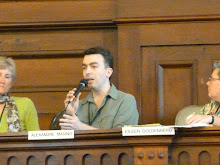
During this year's edition of the Annual International Encaustic Painting Conference, I had the pleasure to be invited by the director, Joanne Mattera, to participate on the main panel. The discussion evolved around the many aspects of having a career as an artist, more specifically artists working with encaustic. The other panelists were Elena De La Ville, Eileen Goldenberg, Barbara Moody, Jane Allen Nodine and Joanne Mattera was the moderator. She delivered many interesting questions and did a great job at keeping the discussion alive with the audience. The panel formed a diverse and interesting group of artists with many different career paths which created a successful and dynamic event. We later decided to put our thoughts and answers in a written form to keep the discussion alive and share our vision on the subject. You may read about the event on the conference blog (click here). Here is my input on the subject.

Question #1
Joanne Mattera : Alexandre, you have a full-time studio practice, though you used to work in a gallery to support yourself. Can you tell us how you were able to make the leap to supporting yourself as a painter?
My leap was more like a long process than a big jump in the void.
Right out of University, I made the conscious decision that all the jobs that I would accept would be art related or at least would require skills that would help me develop a practice as a full time painter. I obviously encountered some really dry times but I knew I didn’t want a full time job; I had to spend as much time as possible in the studio.
I took all kinds of side jobs and at some point they lead one to another. That’s how I became a studio assistant for different painters but mainly for Tom Hopkins. In many respects, this was way more formative than my school years and in times, it felt like I was doing a master degree with him. I learned the daily aspects of running a studio with its many "How to". I met gallery directors, curators and collectors; I met other artists and learned how to wrap and ship a painting…all of these elements were extremely formative.

Besides working as a studio assistant, I did some graphic design for different music groups, artists and other clients. This was farther away from my practice than working in a studio but the skills I learned are still truly useful. I now do all the design for my catalogues, ads and most of my invitation cards. Knowing how to use Photoshop and Quark X-Press is crucial to my practice and in the promotion of my career.
On top of these two main jobs, I was doing theater sets and stage lighting. Finally I was offered a job in a gallery, first to hang the shows and then to do all the different aspects of running the business. These years were extremely formative. I had the opportunity to meet many, many artists and do the design for several exhibition catalogues. After 3 years, I had pretty much learned what I could and it became repetitive. I had the bad feeling of spending more time promoting other artists instead of my work and I was no longer learning many new things, so I quit. I kept doing side jobs here and there and later as my career took off, I gradually stop doing them.
The most important thing is to be creative in the way we manage our lives, the same way we are creative in making our art.
An entrepreneur opening a business will usually get a credit line. Bankers don’t tend to like artists so we have to find other ways. This is how I could sometimes live a few months by putting everything on my credit card. I would work like crazy on my art and the promotional aspects. It is indeed a life of insecurity but it allowed me to do exhibitions and build up my experience and my C.V. and work 100% on my art.
Two days before this panel, I went to the ICA in Boston and saw some pieces of Tara Donovan. Reading the interview in her catalogue, we learn about her early days. When she was working on her first large installation, she was so broke that even Home Depot declined her a credit card to buy the tar paper she needed. She then took things a step further than me and asked one of her good friend to get the credit card. She purchased what she needed and later paid back her friend. Now, she is showing in museums across the United States and major galleries represent her.

Tara Donovan, Transplanted, 2001
Ripped & Stacked Tarpaper.

Tara Donavan, ICA catalogue
I'm underlying these aspects of the career as it is important to understand that when we see an artist publishing a beautiful catalogue or doing large installations requiring important investments, it doesn't necessarily mean that the artist is the lucky one with family money. It might just be that the artist is in dept but decided that realizing these specific projects was worth the risk.
Spending money on one's career is not an expense, it is an investment.
What ever we do, we have to find ways that works for us and for our situation. This being said, I truly believe in the importance of investing time and energy towards quality. If you do an invitation card, do the best one you can. Get the nicer paper, the nicer reproduction and the nicer design possible, even if it is expensive. Once the card is done, find even more money and buy tons and tons of stamps, and send them out!
Find creative solutions.
I don’t invest in retirement funds, stocks, mutual funds or anything else, every single penny I have goes into my career. Anyway, I'm not planning to retire… I just do what I strongly believe in and I make all my decisions thinking of the long term. Being the flavor of the month never appealed to me.
The Venice Biennale is probably the ultimate Holy Grail event in the Contemporary Art World. It's director, Francesco Bonami, stated in the Tate Magazine of May 2007 that 80% of the young artists shown at the biennale disappeared from the art scene in the last 10 years. I make my decisions thinking of the long term and I remind myself on a regular basis the words of wisdom of Giorgio Morandi: My only ambition is to enjoy the peace and quiet that I require in order to work.

Questions #2
Joanne Mattera : You’re represented by Galerie de Bellefeuille, one of the premier galleries in Montreal. You also show through Canada, in the US, and in Europe. Would you talk a bit about the logistics of exhibiting internationally?
The logistics of showing internationally are basically the same as showing regionally except that everything is way more expensive!
You have to deal with custom papers and brokers, packing the work securely and shipping. Once the show is over, there is the return shipment. You have to pay for your own traveling expenses when attending the openings. There are also the other travel expenses in scouting out possible galleries, meeting curators and dealers. The time and energy spent doing research to find venues is not to be underestimated; sending out catalogues and invitations plays a big part in the firsts steps of the process, but ultimately you have to travel and meet with the people you might or might not work with.
Showing internationally, as an artist doing everything independently, is time and energy consuming and it is indeed expensive. However, I truly believe it is a crucial step in developing a career.
When I started to approach galleries after graduating from University, I went for what I knew and what was close to me in Montréal. They all rejected me… To make things more enjoyable I started a collection of refusal letters as the phrasing in these can be quite bizarre or even funny if you don't take it personal. There is a saying in the art world that if you don't get refusal letters it is because you are not applying to enough projects!
In order to be accepted in galleries and curated shows, it is important to distinguish yourself. When I was approaching galleries in Montréal, I was a painter among many thousand other painters from Montréal. That is when I went to Chicago with my portfolio - on which I had spent two full weeks putting together and doing the design - to approach a gallery I had heard was looking for painters. Being a painter from abroad helped distinguish myself and helped my case as it was good for the gallery (a middle range gallery) to represent international artists. After meeting with the gallery owner three days in a row (during the International Art Fair of Chicago), just minutes before going back to Montréal, she offered me a solo show five months later! It was the first and only time that I was promoted as a French Canadian painter. After that it was easier to distinguish myself in Canada. I was a young painter with a gallery in Chicago.

Like I said earlier, I truly believe in the importance of the quality level of everything that bears our name. It doesn't matter if it is a slide sheet, an invitation card, a blog or anything else, if you want people to be interested in working with you, it has to be of high quality, bearing professionalism. Once you attain this, the second most important thing is to make decisions thinking of the long term. Good art dealers know their business and they will give you good advices. It is important to follow good advices, but it is just as important to know when to stop listening to advices. This may occur when they are only good for the short term and not for the long one.
There are different types of galleries and it is interesting to do business with many of them. Some galleries don't have a beautiful space but they sell. Some galleries have museum like spaces but they don't sell. Some galleries are in the business for more than thirty years and represent 60 or more artists. Other galleries are open for two years and represent twelve artists. All these galleries may be good for our career. It is a question of finding people that you can trust and that you feel comfortable working towards the same goal.
No matter what type of business relations we have with galleries, with curators or anybody else, the most important thing is to stay in control of our production and not to be pressured by the necessity of a certain venue or a certain market. It seems obvious but it is more difficult to follow then we think. Mira Schor (website, blog) wrote a beautiful essay on the subject entitled On Failure and Anonymity that we find in her book Wet. The whole essay is filled with poignant notions but here are a few quotes:

Expectations of glory veil the real life of the artist, and if being in the studio is the priority, the life is difficult.
Real success is the ability to continue making art that is alive.
To survive the long run to continue to function, someone ought to tell you that there is a long run. To survive, it is necessary to stand for something within yourself and yet always doubt your own deepest beliefs. It is necessary to have the agglomeration of terrors and hopes, delights and doubts that make up a soul. Perhaps a soul is culturally bound and determined, but it can be more than a slave to fashion. Follow fashion and be fifteen minutes late. Trends are fleeting. A lifetime of art cannot be built on a weather vane.
The life of the work, the ecology of the studio is what I am interested in, when the doors are closed on the pressures of the marketplace. And in this life there is always failure, no matter how much money is made. For it is a given that there is always a gap between what the artist wants the work to be and what it is, between the original goal and the weird paths that are taken. Life continues only as long as the blind chase down the path. There is tremendous fear on that chase because the relationship between artist and artwork is one of intimacy with the self, and intimacy is truly terrifying and can never be fully achieved.
The greatest thing an art school could give a student is access to this anonymous life of the studio, recognition of its supreme importance to the inner survival of the artist and to the creation of meaningful art that transcends fashion and money.

Question #3 (Question not asked in the panel due to time issues)
Joanne Mattera : You have done several residencies. What have they done for your career, both in terms of helping you develop the work and in terms of advancing your career as a result of the time and money accorded to you?
From my experience and the type of residencies that I have attended, they have a bigger influence on the work than on the career. They give you a great opportunity to travel but mostly a window of time in which the only thing to think of and focus on is the art practice.
There are many types of art residencies; either you have many artists at once in a large facility like the Banff Center in Canada, or a single artist is given a studio in a remote place. The only residencies that I attended are of the later. They obviously didn’t help me networking but they gave me the occasion to fully concentrate on my work without internet, phone or the pressure of the art world.
I did a residency, offered by the Brucebo Foundation, where I was awarded a studio on Gotland Island in the middle of the Baltic Sea for 3 months with nothing else to do but paint and take long walks. It had a big impact on my practice since this is where I started to focus on the many possibilities of doing landscapes. Without the residency, I probably would not be showing with the Luminous Landscape collective in parallel to this conference.

Questions from the audience: There were many questions, here are a few...
What was the impact of the recession on your art practice and career over the last years?
The recession happened right when I was about to increase my prices. I obviously couldn't do it, so it did have an impact. I had solo exhibitions that did not sell like it should have, so it did have an important economical impact. The place where it didn't affect me is in my studio practice. I had galleries who wanted smaller size paintings as it was easier for them to sell. Other galleries wanted large-scale paintings as they brought in more money for each sale. I just kept doing what I do and dispatched the work to the galleries. We do have a strange life; the more we work the more we spend.
Have you decided to start doing encaustic monotypes because of economical reasons associated or not with the recent recession?
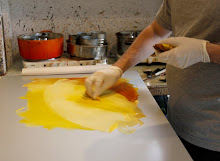
No. I have always loved works on paper, encaustic is my medium of predilection so ever since I heard about encaustic monotypes - which was prior to the recession - I had wanted to explore this technique. The fact is that in order to show works on paper in galleries, they need to be framed and lots of clients are reluctant to buy and hang works framed with a glass. There are other ways of framing monotypes but they tend to loose the beautiful fragility of the paper that I love. Therefore, it is not because they are smaller and less expensive that they are necessarily easier to sell. I have galleries who want them and others who don't and this emphasizes the importance of having different types of galleries. I do them because I love to do them.
Are there stigmas associated to the fact of showing in a co-op gallery?
I believe there is a stigma with anything we do in the art world. Let's decide that we don't care and just do what we have to do.




 Posts
Posts

